NEWS & EVENTS

NEWS & EVENTS
China Debuts Its First Fully Prefabricated Metro Entrance/Exit Assembly
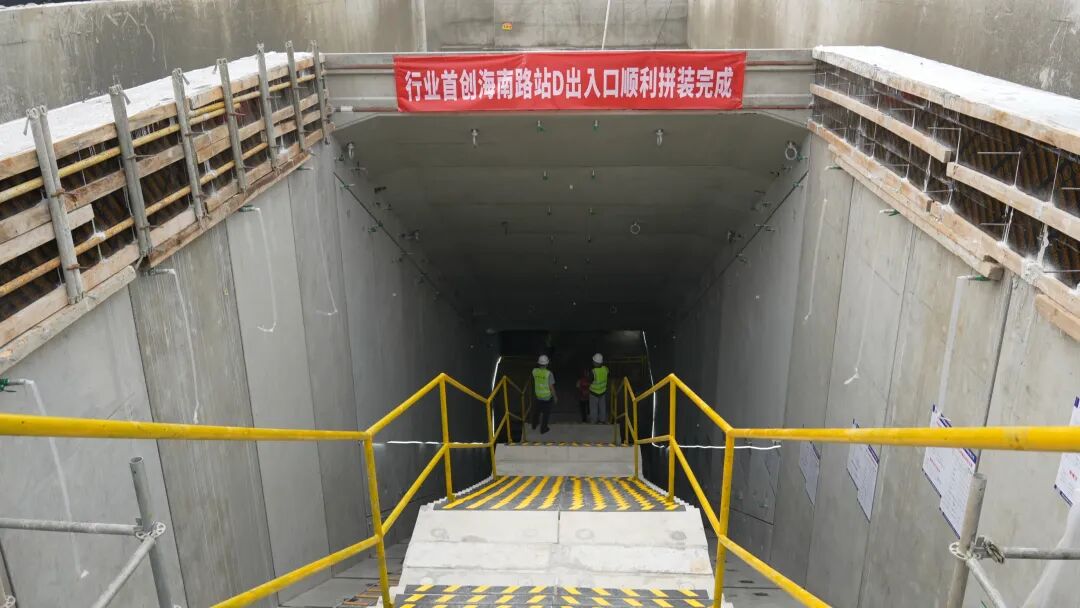
Recently, the assembly of a fully prefabricated entrance/exit at Hainan Road Station of Qingdao Metro Line 6 (Phase 2 project), for which UCD serves as the main design participant, was completed smoothly, marking the national debut of a fully prefabricated metro entrance/exit.
Previously, UCD had pioneered the application of prefabricated station main bodies, platform slabs, T-shaped stairs, and other design technology in the course of designing the Phase 1 project of Qingdao Metro Line 6. The practical application of the fully prefabricated entrance/exit technology demonstrates that UCD’s research and development team has mastered the entire chain of prefabricated construction for metro stations, including main bodies, internal frameworks, and ancillary structures. This will drive the integration and upgrading of existing prefabrication systems and expand their application scope, offering a model example for professional peers.
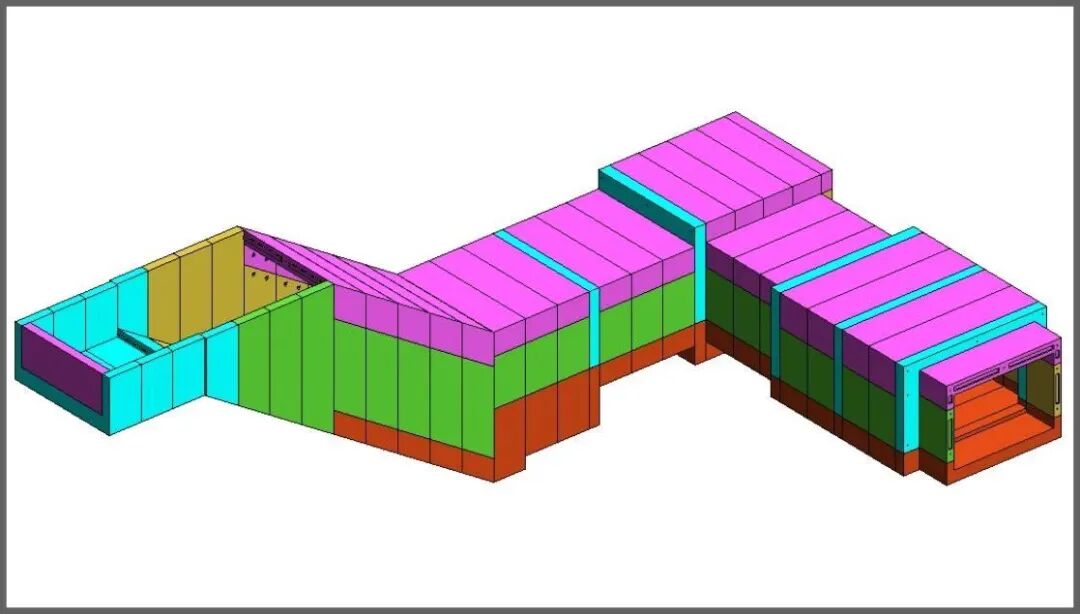
Schematic Diagram of the Prefabricated Entrance/Exit Structural Type
The Phase 2 project of Qingdao Metro Line 6 is situated in Huangdao District, extending westward from Qingxi Station and eastward to Xintun Road Station, the terminal of the Phase 1 project. It features 10 underground stations, with a total length of 13.84 km. In normal circumstances, metro entrance/exit construction suffers from confined work sites, complex geological conditions, tight schedules, heavy tasks, and high safety hazards from concurrent operations. In addition, diverse entrance/exit slopes, depths, and plan shapes, as well as multiple structural forms, make it extremely hard to complete standardized component design and assembly within limited spaces. As a result, the full-ring assembly of entrance/exit structures has not been successfully implemented, whether in China or foreign countries.
Based on extensive research and practical exploration in the field of prefabricated underground structures over the years, and with due consideration of the practical circumstances of entrance/exit design and construction, UCD proposed a nationally innovative prefabricated structural type and construction approach that is suitable for diverse geological conditions and multiple foundation pit support systems. Entrance/exit passages and ring-frame components are standardized and prefabricated off-site, while on-site assembly follows a highly efficient building-block procedure, ultimately enabling the prefabricated assembly of entrances/exits in all segments and all forms.
Moreover, UCD’s self-developed techniques, such as precision mortise-and-tenon grouting joints, prestressed tensioning, and integrated sealing and waterproofing, assist in achieving millimeter-level assembly precision, which not only substantially raises construction efficiency but also makes a leap forward in structural safety, water resistance, and durability.
So far, the “Prefabricated Assembly Technology for Metro Stations” has seen large-scale deployment in Changchun, Qingdao, Shenzhen, and Chongqing, underpinning the construction of over 60 assembled stations and extending to highway and railway projects.
Over the years, UCD has consistently prioritized technology-driven innovation as a driver to progress toward industrialized, green, and intelligent development. The self-developed prefabricated assembly technology for metro stations has broken new ground in China, and the world’s first prefabricated assembly technology and process system for internal structures tailored to the metro station context delivers three core technologies: comprehensive construction of assembled internal station buildings, monolithic full-prefabricated construction of track-level ventilation ducts, and a new composite platform slab structural system. Apart from that, UCD continues to expand its capabilities in the prefabricated interior sector by establishing a full-chain technology system that encompasses assembly design, parts production, green building materials, and digital monitoring and control. Representative patents include modular interior decoration systems, modular bathrooms, bathroom ceiling systems, etc.
Moving forward, UCD will take this technological breakthrough as an opportunity to reinforce industrial standardization efforts, pay attention to overcoming key challenges in prefabricated assembly technologies for underground excavation structures, improve construction processes iteratively, and leverage technological innovation to facilitate the transformation of construction models, thereby contributing strong support to the high-quality development of urban rail transit.