NEWS & EVENTS

NEWS & EVENTS
The Standard for Design of Metro Has Passed Expert Review
Recently, the review meeting for the draft for review of the Standard for Design of Metro, a national standard led by UCD in its revision, was convened in Beijing. Attendees included leaders from the Department of Standards and Quotas, Department of Project Quality and Safety Supervision, Urban Construction Department, and Research Institute of Standards and Norms of the Ministry of Housing and Urban-Rural Development. On behalf of the lead organization, Xia Xiujiang (Party Secretary, Chairman, and General Manager of UCD) delivered a speech.
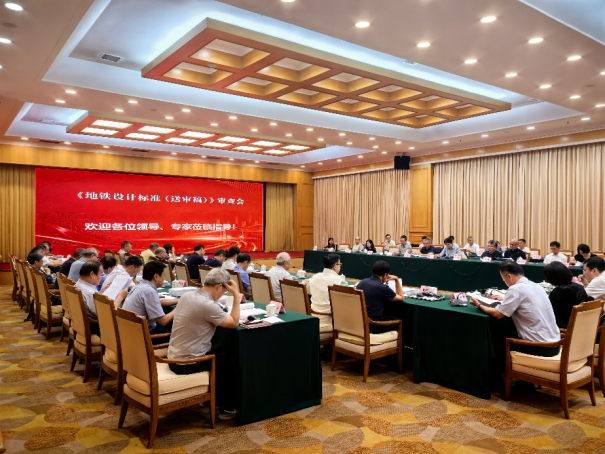
In his speech, Mr. Xia pointed out that this revision marks a significant elevation in the standard’s overall positioning. Grounded in today’s critical issues, including digitalization, intelligence, green, low-carbon, and security resilience, this revision establishes three core orientations: transport-function-first, systematic cost reduction and efficiency gains, and high-quality sustainable growth. By harnessing synergies across functional essence, economic performance, and long-term value, it delivers forward-looking and systematic technical guidance for metro construction in the new era.
Led by Chen Xiangsheng, Academician of the Chinese Academy of Engineering, the 37-member review group engaged in comprehensive questioning and discussion on the Standard chapter by chapter and clause by clause. They unanimously found it well-documented, complete in professional scope, and scientifically robust in its technical framework, with strong operability and applicability. They thought it could be added to the list of the world’s advanced standards and consequently approved it.
First issued in 1992 and led by UCD, China’s first urban rail transit design code, the Code for Design of Metro, is widely recognized as the “parent code” and has consistently provided crucial technical support for the development of urban rail transit across the nation for more than three decades.
This revision is chaired by Yang Xiuren, National Engineering Survey and Design Master, and involved 11 collaborating organizations over several years of dedicated efforts. Key technical upgrades include: an increase in the maximum operational speed from 100 km/h to 120 km/h and the addition of the express/local train operation mode; a newly established chapter on Information Systems to incorporate full automation, cloud platforms, and AI technologies; the addition of a chapter on Energy Conservation to strengthen requirements for vehicles, power supply, HVAC, and lighting; and a significant reinforcement of flood prevention clauses to boost resilience against water hazards in all respects.
With the draft for review passing the review, this revision makes a key achievement. Moving forward, UCD, jointly with all participating organizations, will fully incorporate the review comments, fast-track the approval process, and prepare for subsequent dissemination and application.