NEWS & EVENTS

NEWS & EVENTS
China Releases Its First National Standard Related to Elderly-oriented Urban Rail Transit
Recently, the national standard General Technical Requirements for the Elderly-oriented Basic Equipment and Installations for the Urban Rail Transit (GB/T 47732-2026), compiled under the leadership of UCD, was officially unveiled in China. As the first comprehensive national standard in China’s urban rail transit sector, it covers all age-friendly scenarios, encompassing planning, design, construction, operation and passenger travel, and will take effect on September 1, 2026.
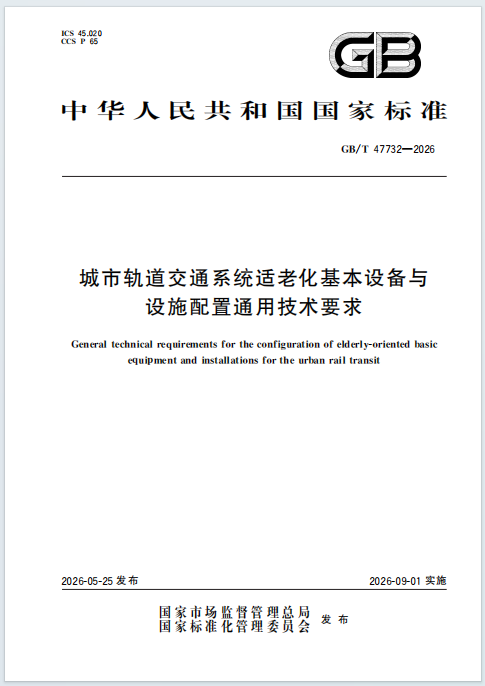
To deeply fulfill the national strategy for actively responding to population ageing, the National Standardization Administration rolled out a special initiative in March 2023, which includes both the formulation of recommended national standards for elderly-oriented renovation and the development of their foreign-language versions. Taking the position of chief editor, UCD was responsible for preparing the standard in both its Chinese and foreign-language editions. The drafting process spans three years, bringing together the concerted efforts of over 20 domestic organizations in the rail transit sector, ranging from design, construction, operations, and vehicle manufacturing. Additionally, it represents a broad synthesis of industry-wide consensus and professional expertise. At present, the Chinese version of the national standard has been officially released, while the English version is essentially finalized.
According to the standard, elderly-oriented equipment are required to be planned, designed, built, accepted, and brought into operation in sync with the main rail transit project, ensuring the above two can be executed in an integrated manner from the very beginning. In terms of the full travel chain for elderly passengers, the standards sets up five standardized technical frameworks, involving age-friendly circulation routes, access facilities, service equipment, information and communication installations, and vehicles, to fully integrate with existing barrier-free facilities through coordinated allocation and resource sharing, delivering a cohesive, well-supported, and easy-to-use travel environment for senior citizens.
Upon implementation, the standard is expected to generate two key benefits for the urban rail sector. First, it provides a unified technical benchmark for age-friendly design across all new rail transit projects with exclusive right-of-way, and arranges for elderly-oriented equipment at the stage of planning, dramatically lowering the investment needed for post-construction modifications. It can also serve as a reference for the upgrade and renovation of lines without exclusive right-of-way as well as existing line reconstruction and expansion projects, offering a nationally recognized technical benchmark for elevating age-friendly facilities throughout China’s rail transit sector. Second, by fully implementing the national strategy for actively responding to population ageing, the standard will systematically resolve various travel challenges faced by senior citizens, and foster the creation of urban rail transit environments friendly to all age groups, thus effectively enhancing the sense of gain, well-being, and security among senior citizens.
The issuance of this standard is expected to provide unified, normative, and reasonable technical support for the age-friendly development of urban rail transit in China, assisting in building a more inclusive, convenient, and safe urban public transportation environment.