NEWS & EVENTS

NEWS & EVENTS
UCD Wins Five Awards in the National “Better Housing” Design Competition
Recently, the Ministry of Housing and Urban-Rural Development announced the winners of its National “Better Housing” Design Competition. Five works designed by Beijing Institute of Residential Building Design & Research Co., Ltd. (BRDR), a subsidiary of UCD, were included among the 83 award-winning works, with three second prizes, one third prize, and one excellence award. This accomplishment highlights UCD’s expertise in designing high-quality houses.
Under the theme of “Design for the People: Better Housing, Better Living”, this year’s National “Better Housing” Design Competition aims to inspire the creative enthusiasm of designers and young students, and leverage “better design” to create “better housing” that truly satisfy the people.
The competition features two categories: New Housing Design and Renovation and Upgrade of Existing Housing. It further includes Professional Group and Student Group. It attracted more than 1,700 participants from 144 universities/colleges and 602 design institutions at home and abroad, with the submission of 2,000 design schemes. After multiple-round reviews by industry experts, 83 outstanding design schemes were honored with awards, including 5 works from BRDR. It fully demonstrates the company’s strong technical competence and innovative application in designing “better housing”.
Park Living, Future Home — Better Housing near the Beijing Expo Park
New Housing Design (Second Prize)
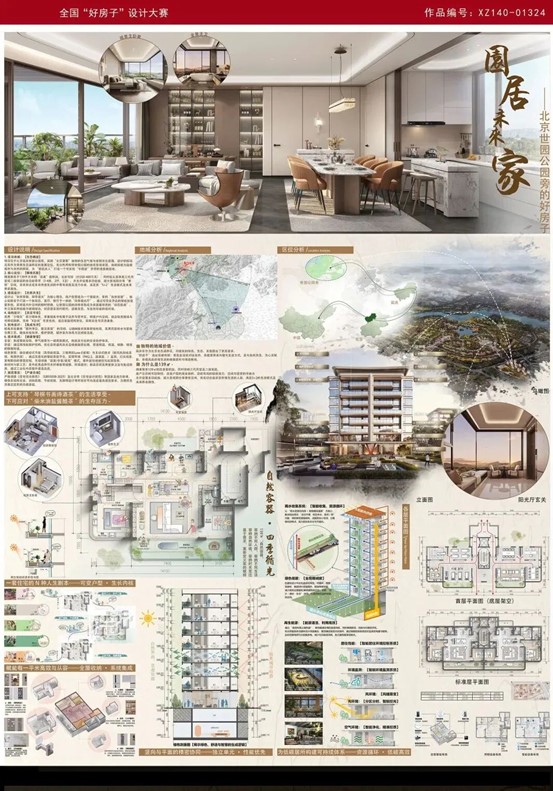
Centered around the Beijing Expo Park in Yanqing District, this work embraces the philosophy of “Finding Solace in the Park, Coexisting Intelligently with Nature” to create a space named “Nature’s Vessel, Where Light Dances Through the Seasons”. The LDKB (Living Room-Dining Room-Kitchen-Balcony) circulation route, operable folding windows and other design methods are used here to achieve a seamless integration of the scenic park with everyday life. This work applies a lifecycle adaptable floor plan that evolves with family needs at different stages. It sets a new benchmark for innovative housing practices in ecological conservation areas by means of the fusion of ultra-low energy consumption technology, ground source heat pumps and smart regulation systems.
Youth Lifestyle Modules
New Housing Design (Second Prize)
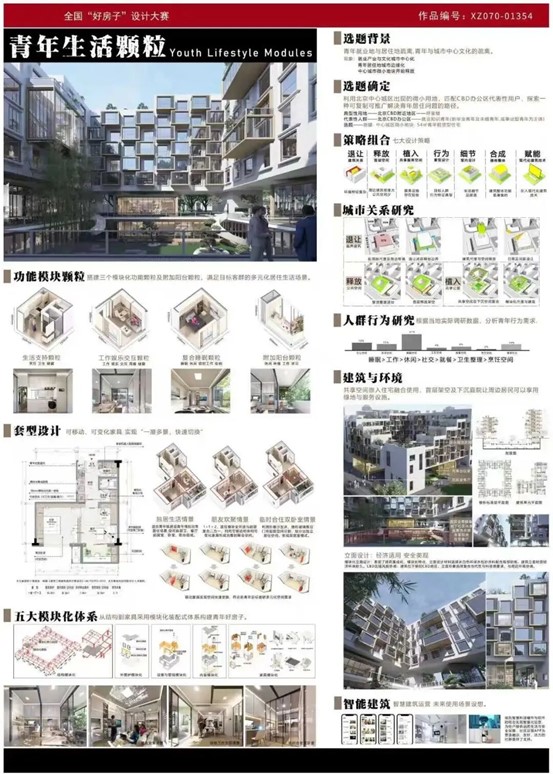
In response to the actual rental needs of the younger generation in the CBD of Beijing, this work leverages small leftover urban spaces in the city core to explore the creation of a replicable design model for youth-oriented affordable rental housing. The design synthesizes the younger generation’s six essential living demands into three functional modules, and then delivers highly adaptable spaces through the application of modular prefabricated systems from structure to furniture. Smart operations and technological innovation will support the building of good houses for young residents, where living conditions can be upgraded and the future is full of possibilities.
The Health Guardian Home — A Lifecycle Dwelling for Pre-Senior Couples
Renovation and Upgrade of Existing Housing (Second Prize)
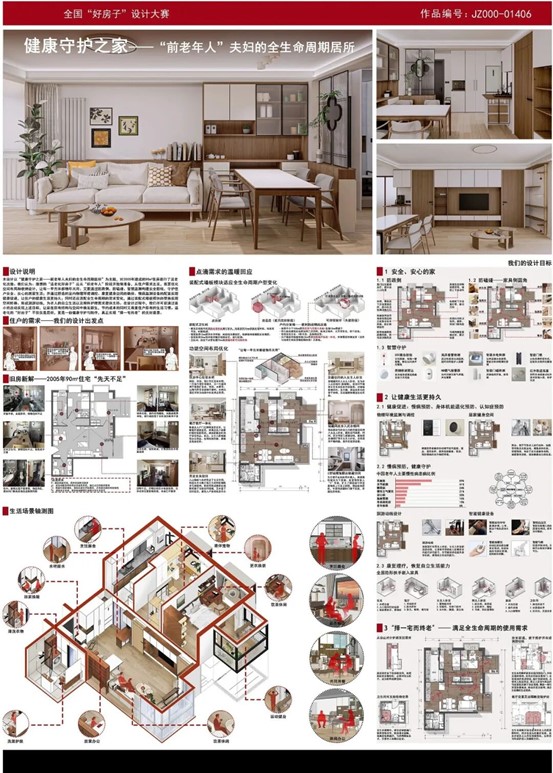
Based on a real residence (20 years old, 90.3 m²), this work creates an aging-friendly renovation scheme with minimal alterations. With a philosophy of “plan early, adapt early”, it streamlines spatial organization to meet the unique needs of pre-senior residents by prioritizing safety through fall prevention and intelligent monitoring systems, and safeguarding health with a comfortable indoor climate and chronic condition tracking. The incorporation of prefabricated technology and a circulation path ensures that the home evolves with its inhabitants, supporting both self-reliance and caregiving needs.
A Building at the Foot of the Temple of Heaven
New Housing Design (Third Prize)
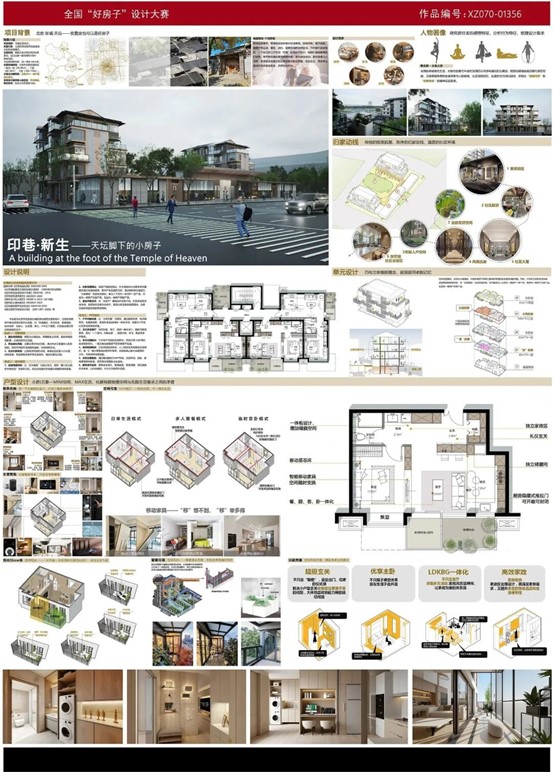
Rooted in the cultural context of the Temple of Heaven, this work echoes the city landscape through its enclosed plan and neo-Chinese style. By creating the “vertical courtyard” concept, it explores different product portfolios and sustains the sentimental connections of long-time residents. This work designs multi-level shared spaces within the public areas. Features such as the integrated living-dining-kitchen-balcony-garden (LDKBG) layout, adaptable floor plans, expansive multi-scenario horizontal living room, high-efficiency storage, smart home technology, and all-season balconies transform these old houses into exemplary good ones. They are spaces where cultural continuity meets emotional connection, where functionality is enhanced by technology.
Beyond Boundaries, Wandering Home
New Housing Design (Excellence Award)
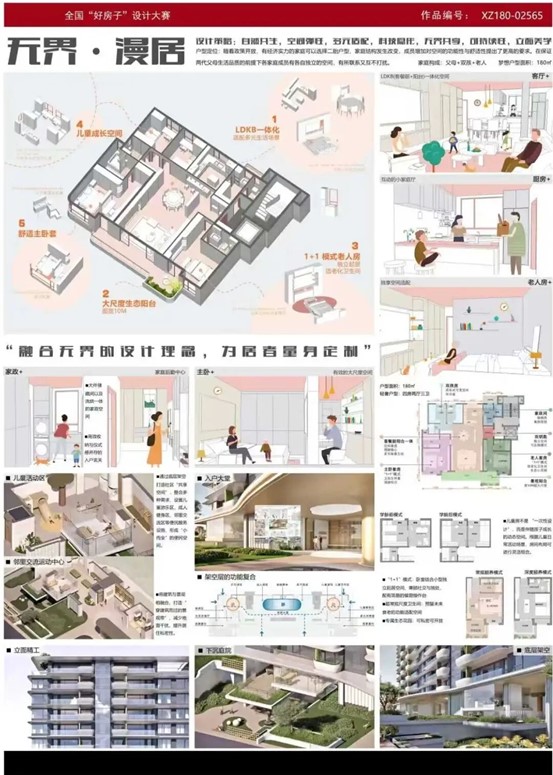
It is a work for newly-built houses. Focusing on three-generation houses, this design aims to address the spatial flexibility of such houses by creating a spatial design that accommodates multiple age groups, adapts to various scenarios, and allows for diverse transformations. Its dual-key design not only offers flexible privacy solutions for diverse living requirements, but also keeps a balance between smart home and cost-effective maintenance. By integrating shared areas with the community’s micro-ecosystem, this work sets up a flexible and open residential environment.